
Home / All / Composite Steel Plate / 304 + 1060 + 304 Stainless-Aluminum-Stainless Clad Plate | MESCO
304 + 1060 + 304 Stainless-Aluminum-Stainless Clad Plate | MESCO
The Ultimate Teppanyaki Griddle Panel Material
SS-Al-SS Composite Plate · Tri-Clad Steel · Stainless Clad Aluminum · Induction Griddle Panel
Thermal Conductivity ~100–140 W/(m·K) · No Hot Spots · Food-Safe 304 Surface · No Seasoning Required
SS-Al-SS Composite Plate · Tri-Clad Steel · Stainless Clad Aluminum · Induction Griddle Panel
Thermal Conductivity ~100–140 W/(m·K) · No Hot Spots · Food-Safe 304 Surface · No Seasoning Required
Detail Information
What Is 304+1060+304 Clad Plate?
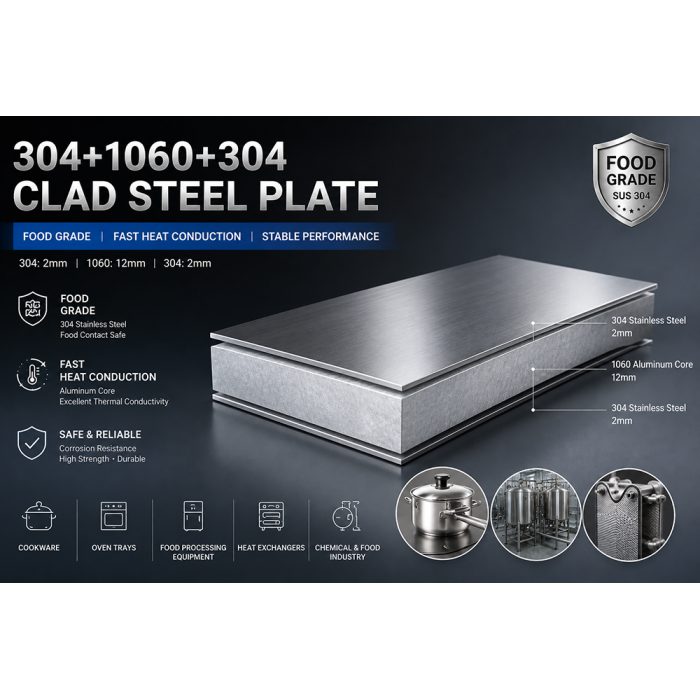
304+1060+304 clad plate — also referred to as SS-Al-SS composite plate, stainless-aluminum-stainless tri-clad, or stainless clad aluminum plate — is a three-layer laminated metal panel produced by permanently bonding two outer skins of AISI 304 stainless steel to a core of 1060 pure aluminum through hot-roll cladding under high temperature and pressure. The result is a single structural panel in which each layer performs a distinct engineering function — and the combination produces performance that neither material achieves alone.
For teppanyaki griddle and commercial cooking surface applications, 304+1060+304 clad plate solves the fundamental trade-off that has long forced kitchen equipment designers to compromise: pure stainless steel is hygienic and corrosion-resistant but distributes heat poorly, while aluminum distributes heat superbly but is too soft and reactive for direct food contact. By placing 304 stainless on the outside and aluminum on the inside, the clad plate delivers aluminum-speed heat distribution with a stainless steel cooking face — no compromise.
The bond between layers is metallurgical, not adhesive. At the cladding interface, atoms from the 304 and 1060 surfaces interlock under high-pressure hot rolling, creating a permanent joint that will not delaminate through thermal cycling, moisture, or mechanical stress in normal service.
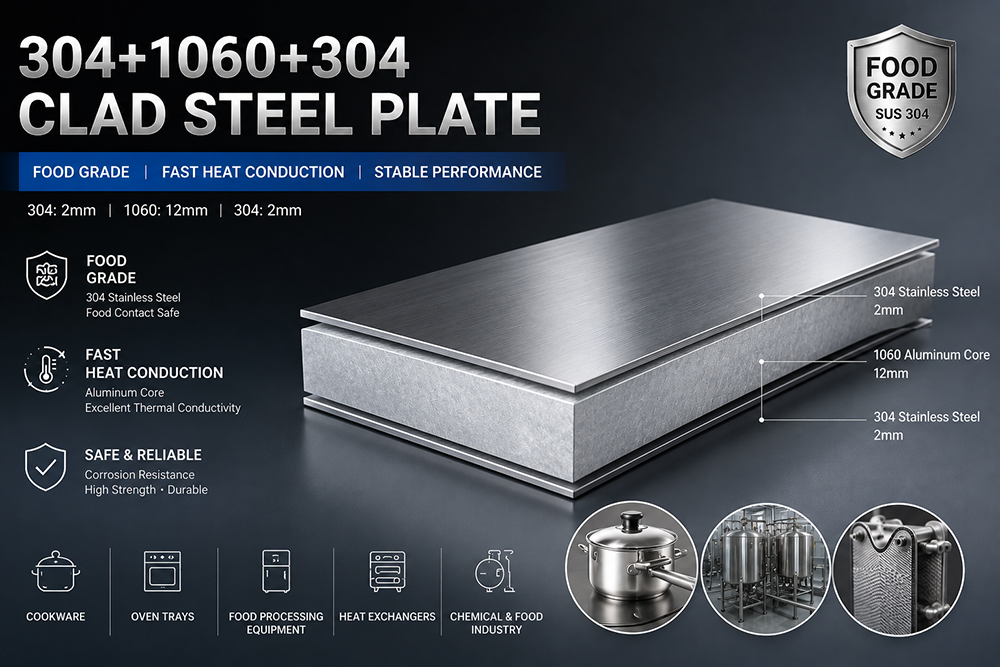
Product Structure: Three-Layer Sandwich
LAYER 1 — 304 Stainless Steel (Top Surface)
Food-safe · Corrosion-resistant · Easy-clean · Non-reactive with oils and acidic ingredients
CORE — 1060 Pure Aluminum
Thermal conductivity 209 W/(m·K) · Rapid, uniform heat distribution · No hot spots
10–40× more thermally conductive than stainless steel alone
LAYER 3 — 304 Stainless Steel (Bottom Surface)
Structural strength · Warp resistance · Compatible with induction, gas, and electric heat sources
The Science of Fast, Uniform Heat: Why the Aluminum Core Changes Everything
Thermal Conductivity: The Number That Matters
Thermal conductivity measures how fast a material transfers heat — higher is faster and more uniform. Compare the three materials in this panel:
| Material | Thermal Conductivity | vs 304 SS |
| 304 Stainless Steel | ~16 W/(m·K) | Baseline (1×) |
| Cast Iron | ~50 W/(m·K) | ~3× faster |
| 1060 Pure Aluminum (core) | ~209 W/(m·K) | ~13× faster |
In a clad plate with a dominant aluminum core (e.g., 1:8:1 ratio), the effective thermal conductivity of the panel falls in the range of 100–140 W/(m·K) depending on the layer ratio — roughly 7–9 times better than solid stainless steel and significantly better than cast iron, at a fraction of the weight.
What This Means at the Cooking Surface
When a gas burner or induction element heats the underside of a clad panel, the aluminum core instantly redistributes that energy horizontally across the full panel area. By the time the heat reaches the 304 cooking face above, it has already been spread across a much larger area. Temperature sensors placed at the center and edge of a properly clad panel show variations of less than 10–15 °C across the full cooking zone. On a single-layer stainless panel of the same thickness, the same burner produces center-to-edge differences of 80–120 °C — the definition of a hot spot.
For teppanyaki cooking, where a single griddle surface is simultaneously used for proteins, vegetables, and fried rice at different heat demands, uniform surface temperature is not a comfort feature — it is the fundamental requirement for consistent food quality across every guest's plate.
Performance Comparison: Clad Plate vs Alternatives
| Property | Cast Iron | 304 SS Only | 304+1060+304 Clad
(This Product) |
| Thermal Conductivity | ~50 W/(m·K) | ~16 W/(m·K) | ~100–140 W/(m·K)* |
| Heat Uniformity | Good (heavy mass) | Poor — hot spots | Excellent — no hot spots |
Preheat Time | Long | Medium | Short — fast response |
Corrosion Resistance | Poor — seasons needed | Excellent | Excellent (304 surface) |
Food Safety | Seasoned only | Excellent | Excellent |
Weight | Heavy | Light | Medium — balanced |
Warp Resistance | Excellent (rigid) | May warp thin gauge | Excellent — steel skins |
Cleaning | Requires seasoning | Easy | Very easy — smooth 304 |
| Induction Compatible | Yes | Yes (magnetic grades) | Yes (magnetic 304 base) |
Key Advantages for Teppanyaki and Commercial Cooking Applications
Fastest Heat-Up in Class
The 1060 aluminum core reaches cooking temperature in 30–50% less time than solid 304 SS panels of equivalent thickness — reducing energy cost and service wait time.
Zero Hot Spots
Al conductivity (209 W/m·K) spreads heat laterally across the entire cooking surface before it reaches the 304 face. Food cooks evenly wall-to-wall — no burnt center, no cold edges.
Food-Safe 304 Surface
The cooking surface is pure 304 stainless steel — non-reactive with acidic sauces, marinades, and oils. No seasoning required. Compliant with FDA and EU food-contact standards.
No Warping Under Heat
The symmetric 304-Al-304 sandwich structure resists thermal bowing. Matching top/bottom skin thicknesses balance thermal expansion stresses — the plate stays flat through heating cycles.
Induction + Gas + Electric
304 stainless outer layers are magnetic-grade compatible, making the panel suitable for induction, gas, electric, and ceramic heat sources without modification.
Effortless Cleaning
Smooth 304 surface releases food residue easily. Dishwasher-safe. No rust, no staining, no re-seasoning — unlike cast iron. BA or mirror finish available for premium installations.
Key Product Features
- Three-layer structure: 304 SS / 1060 Al / 304 SS — permanent hot-roll metallurgical bond, no delamination
- Thermal conductivity ~100–140 W/(m·K) effective — 7–9× better than solid 304 SS
- Food-safe 304 surface — non-reactive, no seasoning required, dishwasher-safe
- Compliant: FDA 21 CFR, EU 1935/2004, GB 9684 food-contact metallic materials standard
- Surface finish options: 2B / BA / #4 brushed / mirror — specify at order
- Induction + gas + electric + ceramic heat source compatible
- Flatness ≤ 2 mm/m — critical for full-contact cooking surface uniformity
- Total thickness 3–20 mm; layer ratio customizable (e.g., 1:6:1, 1:8:1, 2:8:2)
- Panel size up to 1,500 mm × 6,000 mm; custom cut-to-size available
- Standards: GB/T 8547, ASTM A263, JIS G 3602
- Full documentation: MTR, chemical analysis, flatness cert, RoHS declaration
Technical Specifications
| Parameter | Specification |
| Product Name | 304 / 1060 / 304 Stainless-Aluminum-Stainless Clad Steel Plate |
| Trade Names | Tri-Clad Plate · SS-Al-SS Composite Plate · Stainless Clad Aluminum · Teppanyaki Clad Panel |
Layer Structure | 304 SS (top) + 1060 Pure Aluminum (core) + 304 SS (bottom) |
Bonding Method | Hot-roll explosive cladding / roll-bonded — permanent metallurgical bond |
Top / Bottom Layer Grade | AISI 304 (UNS S30400) — 18% Cr, 8% Ni |
Core Layer Grade | AA 1060 Pure Aluminum — Al ≥ 99.6% |
Thermal Conductivity (core) | ~209 W/(m·K) for 1060 Al; effective panel ~100–140 W/(m·K) |
Total Thickness Range | 3 mm – 20 mm (custom) |
Layer Ratio (SS:Al:SS) | 1:8:1 standard; custom ratios available (e.g., 1:6:1, 2:8:2) |
Panel Width | Up to 1,500 mm |
Panel Length | Up to 6,000 mm; custom cut-to-size |
Surface Finish (304) | 2B / BA / brushed / mirror — specify when ordering |
Max. Operating Temp. | 300 °C continuous (limited by Al core softening); 350 °C short-term |
Flatness Tolerance | ≤ 2 mm/m (critical for teppanyaki surface contact uniformity) |
Food Contact Safety | 304 SS surface — compliant with FDA, EU 1935/2004, GB 9684 |
Weld / Fabrication | 304 outer layers weldable by TIG/MIG; Al core requires edge sealing |
Standards Reference | GB/T 8547, ASTM A263, JIS G 3602 |
Application Scenarios
Teppanyaki Griddle Panels — Primary Application
The defining application for 304+1060+304 clad plate is the teppanyaki iron plate. Whether in a countertop single-burner unit for a home kitchen or an 8-seat restaurant installation spanning multiple gas rings, the clad plate delivers the heat uniformity that teppanyaki cooking demands. The chef works across the entire surface simultaneously — proteins here, vegetables there, rice at the far end — and every zone must be at the right temperature without manual heat-zone management. The aluminum core makes this possible.
Commercial Kitchen Equipment
Beyond teppanyaki, 304+1060+304 clad plate is used in: professional griddle tops and flat-top grilles; hotel buffet hot-plate surfaces; steam-table well liners and bain-marie inserts; pizza oven hearth plates (where fast heat recovery after opening is critical); sandwich press and panini grill plates; and wok station flat surfaces for mise en place.
Catering and Hospitality Equipment
Large-format clad panels are used in banquet chafing dish lids and bases, catering trolley heated surfaces, and event-catering flat-top cooking units where portability demands light weight (aluminum core) but hygiene and durability demand stainless steel surfaces.
Industrial Thermal Management
Outside the food industry, the same heat-spreading properties make 304+1060+304 clad plate useful in: laboratory hot plates, semiconductor process heating platens, ink and coating drying oven bases, and heat-press platens — any application requiring fast, uniform temperature across a flat metallic surface.
Frequently Asked Questions — 304+1060+304 Clad Plate
What is 304+1060+304 clad plate, and why is it ideal for teppanyaki griddles?
304+1060+304 clad plate is a three-layer composite material: two outer skins of AISI 304 stainless steel permanently bonded to a core of 1060 pure aluminum by hot-roll cladding. For teppanyaki griddle applications, this structure combines the best of both metals: the 304 surfaces provide a food-safe, corrosion-resistant, easy-to-clean cooking face that needs no seasoning, while the aluminum core distributes heat with exceptional speed and uniformity — eliminating the hot-spot problem that causes uneven cooking on solid stainless or thin single-layer panels.
How does the aluminum core improve heat distribution compared to plain stainless steel?
Stainless steel (304) has a thermal conductivity of approximately 16 W/(m·K). The 1060 aluminum core has a thermal conductivity of approximately 209 W/(m·K) — roughly 13 times higher. In a clad plate, heat applied at any point spreads laterally through the aluminum core far faster than it would through steel alone. By the time the heat reaches the 304 cooking surface above it, it has already been distributed across a much wider area. The result is a surface temperature that is far more uniform across the entire cooking zone, regardless of where the burner or heating element is positioned beneath the plate.
What is the maximum temperature for 304+1060+304 clad plate?
The practical maximum continuous operating temperature is approximately 300 °C (572 °F), limited by the aluminum core — aluminum softens (anneals) progressively above 200–250 °C, and above 300 °C its mechanical contribution to the sandwich structure begins to diminish. For short-duration events (searing, high-heat flash cooking), temperatures up to 350 °C are acceptable. For teppanyaki cooking, typical surface temperatures of 180–260 °C are well within the continuous service range. The 304 surfaces are rated to 870 °C, so the aluminum core is the limiting factor.
Will the layers separate or delaminate over time?
No. Unlike adhesive-bonded laminates, the layers in hot-roll-clad plate are joined by a metallurgical bond — the atoms of the 304 and 1060 surfaces interlock at the interface under high pressure and temperature during manufacture. This bond is permanent and cannot be separated by thermal cycling, water immersion, or mechanical stress within the plate's normal service envelope. There is no adhesive to fail.
Is the cooking surface safe for food contact? Does it require seasoning like cast iron?
Yes, it is food-safe. The cooking face is AISI 304 stainless steel, which is non-reactive with food acids, oils, sauces, and marinades. It complies with FDA 21 CFR, EU Regulation 1935/2004, and Chinese national standard GB 9684 for food-contact metallic materials. Unlike cast iron, 304 stainless does not require seasoning, will not rust if left wet, and is dishwasher-safe. There is no iron leaching into acidic foods.
Can 304+1060+304 clad plate be used with induction cooktops?
Yes. AISI 304 stainless steel is weakly ferromagnetic — sufficient for standard induction cooktop compatibility. The 304 outer layers of the clad plate respond to induction fields, allowing the panel to be heated by induction as well as by gas, electric resistance, or ceramic elements. Note: if stronger induction coupling is required (for commercial high-power induction units), a 430 stainless outer layer can be specified as an alternative to 304.
What thickness and layer ratio should I specify for a teppanyaki panel?
For teppanyaki griddle applications, a total thickness of 6–12 mm is typical, with a layer ratio of approximately 1:8:1 (SS:Al:SS by thickness). A 6 mm panel in 1:8:1 ratio has approximately 0.6 mm 304 per face and 4.8 mm aluminum core. Thicker aluminum cores improve heat uniformity further; thicker 304 faces improve mechanical rigidity and surface durability. Custom layer ratios are available — contact us with your panel dimensions and heat-source specification for a recommendation.
What surface finish options are available for the 304 cooking face?
Standard finishes available: 2B (smooth, matte, most common for commercial equipment), BA (bright annealed, reflective), #4 brushed (linear grain, hygienic and attractive), and mirror (high-gloss, premium presentation). For teppanyaki front-of-house installations, #4 brushed or BA finish provides the best balance of aesthetics and scratch concealment. Mirror finish is available for premium or display installations.
Request a Sample Panel or Quotation
Packaging And Shipping
✉ mesco@mescogroup.com.cn
🌐 www.mescogroup.com.cn
📞 +86-15134565556
Review
- 加载中···
Please send your message to us
- Phone
- *Title
- *Content